Tree work at height is not simply “someone with a chainsaw up a ladder.” It is a high-risk, highly technical operation that requires planning, training, specialist equipment, and strict safety controls. When carried out correctly, aerial tree work appears smooth, controlled, and methodical. When it is not, the consequences can escalate very quickly.
Understanding what a competent contractor should be doing before, during, and after tree work at height will help you make informed decisions and protect both people and property.
1. Detailed Site-Specific Risk Assessment
No two trees — and no two sites — are the same. A competent contractor will always begin with a thorough, site-specific risk assessment before any climbing or dismantling work takes place.
This assessment should consider:
- The tree’s structural condition, including decay, weak unions, or deadwood
- Stability of the root plate and surrounding ground conditions
- Proximity to buildings, roads, footpaths, utilities, and neighbouring properties
- Presence of overhead cables or underground services
- Public access and the need for traffic or pedestrian management
- Weather conditions, particularly wind strength and direction
This is not a box-ticking exercise. It is a structured process designed to identify hazards and determine how those risks will be controlled. In many cases, it will influence the method of access, choice of equipment, and sequence of work.
Under UK health and safety law, including the Work at Height Regulations 2005, employers must plan work properly and take measures to prevent falls or falling objects. A professional contractor takes this responsibility seriously.
2. A Clear and Practised Rescue Plan
Whenever tree work at height is undertaken, there must be a documented aerial rescue plan in place. This is a legal and practical necessity.
A competent contractor ensures:
- A trained aerial rescuer is present on site
- Rescue equipment is prepared and readily accessible
- All team members understand the rescue procedure
- Emergency access and contact details are clearly established
Tree climbing is a dynamic environment. If an incident occurs, rapid response is critical. Planning for emergency scenarios is part of professional preparation — even if that plan is never needed.
3. Proper Climbing and Rigging Systems
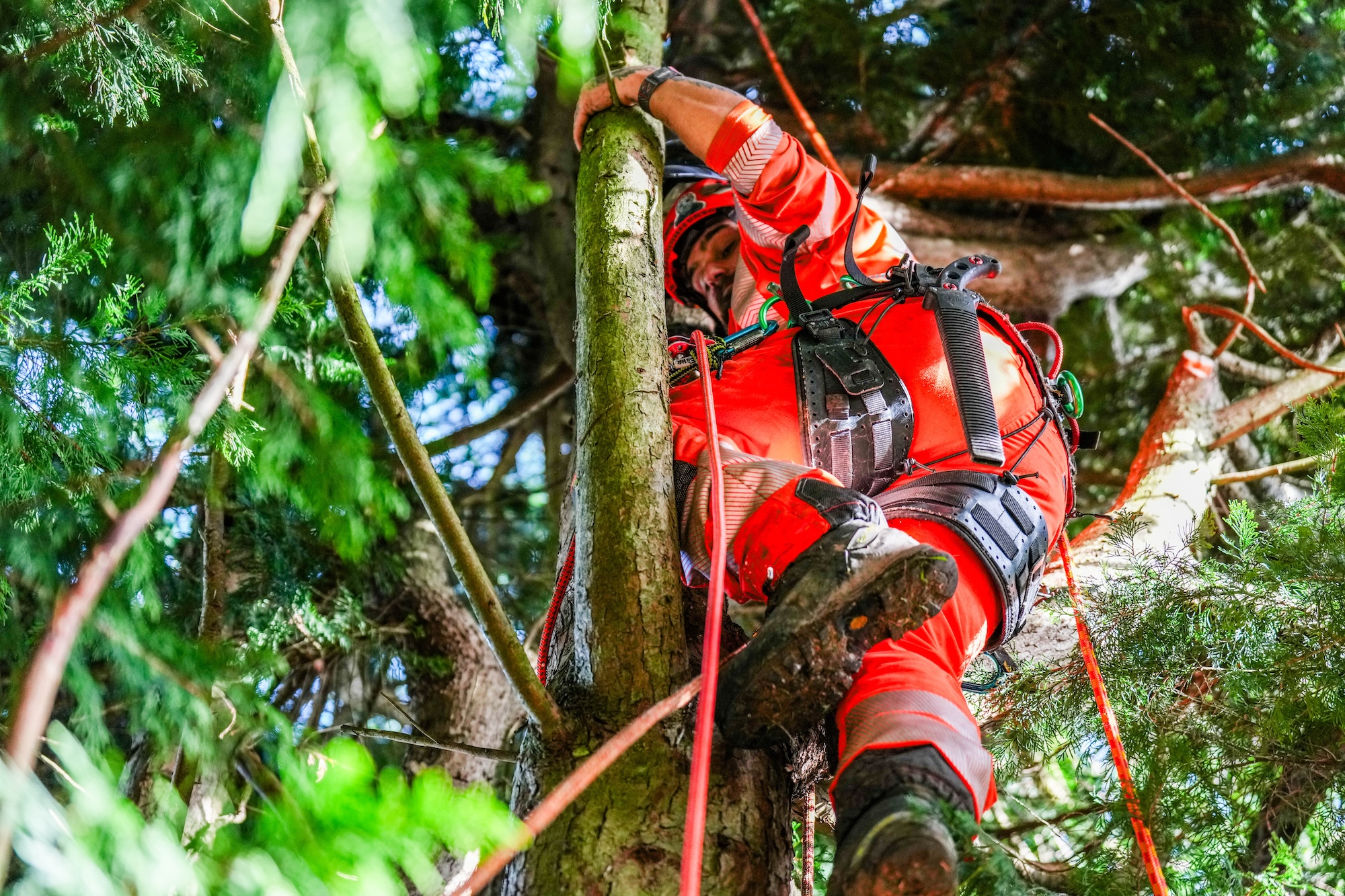
Tree work at height relies on specialist climbing and rigging techniques. Modern arboriculture uses purpose-designed systems that provide stability, redundancy, and controlled movement.
A competent contractor will use:
- Approved climbing systems compliant with current standards
- Secondary anchor points where required
- Rated lowering devices and friction systems
- Rigging ropes selected for appropriate load limits
- Mechanical aids or machinery where site conditions demand it
When dismantling trees — particularly in confined spaces — timber must be lowered in a controlled manner. Cutting and dropping sections without control is unsafe and unprofessional. Controlled rigging protects:
- Buildings and structures
- Landscaping and hard surfaces
- Vehicles
- Members of the public
- The ground crew
Well-executed rigging demonstrates technical competence and experience.
4. Fully Trained and Competent Operatives
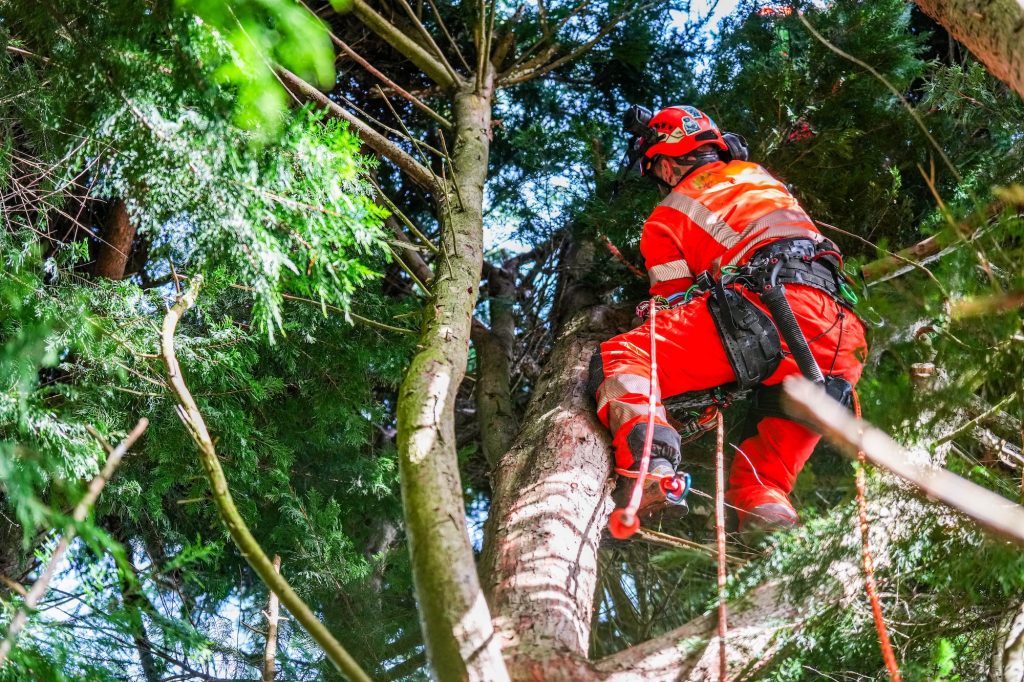
Tree work at height is physically demanding and technically complex. A reputable contractor ensures that all operatives are:
- Appropriately trained and certificated (e.g. NPTC units for aerial operations)
- Experienced in climbing and dismantling techniques
- Equipped with task-specific personal protective equipment (PPE)
- Regularly assessed and refreshed in safe working practices
Experience matters. Understanding how a tree will respond to cuts, how weight shifts within the canopy, and how decay may affect structural integrity are skills developed over time.
Professional aerial work should look calm and controlled — not rushed or improvised.
5. Safe Systems of Work
Competent contractors operate within clearly defined systems of work. This ensures everyone on site understands their role and responsibilities.
A structured approach typically includes:
- Clearly defined roles for climber and ground crew
- Agreed hand signals or radio communication
- Established exclusion zones to prevent unauthorised access
- Equipment inspections before use
- Ongoing dynamic risk assessment throughout the task
Tree work at height often changes as the canopy is reduced or dismantled. A professional team continuously reassesses stability and adjusts technique accordingly.
Compliance with BS3998 and Environmental Responsibilities
All pruning or dismantling work should be carried out in line with BS3998:2010 Tree Work – Recommendations. This ensures that structural pruning objectives are appropriate and that cuts are positioned correctly to support effective compartmentalisation of pruning wounds.
Where trees are protected by a Tree Preservation Order (TPO) or located within a Conservation Area, consent must be obtained before works commence (unless statutory exemptions apply).
Wildlife considerations must also be addressed. Nesting birds and protected species must be checked for prior to starting work.
Why Choosing the Right Contractor Matters
Poorly managed tree work at height can result in:
- Serious injury
- Structural damage to property
- Insurance complications
- Legal liability
- Enforcement action
This is not an area where shortcuts are acceptable. Competence, planning, and professionalism directly affect safety outcomes.
An Approved Contractor You Can Trust
Devon Tree Services delivers complex aerial tree work safely and efficiently across Devon. From sectional dismantling in confined residential gardens to crown reductions on mature trees and storm-damaged removals, every project is planned with safety and compliance at its core.
Our approach combines:
- Site-specific risk assessment
- Structured rescue planning
- Professional climbing and rigging systems
- Fully trained operatives
- BS3998-aligned tree management
If you require tree work at height carried out safely, competently, and with minimal disruption, our team is here to help.
Need Advice?
Not sure whether your tree requires aerial work or can be managed from ground level?
Contact Devon Tree Services for straightforward, expert guidance and a professional assessment tailored to your site.
Phone: 01803 814126
Email: info@devontreeservices.co.uk