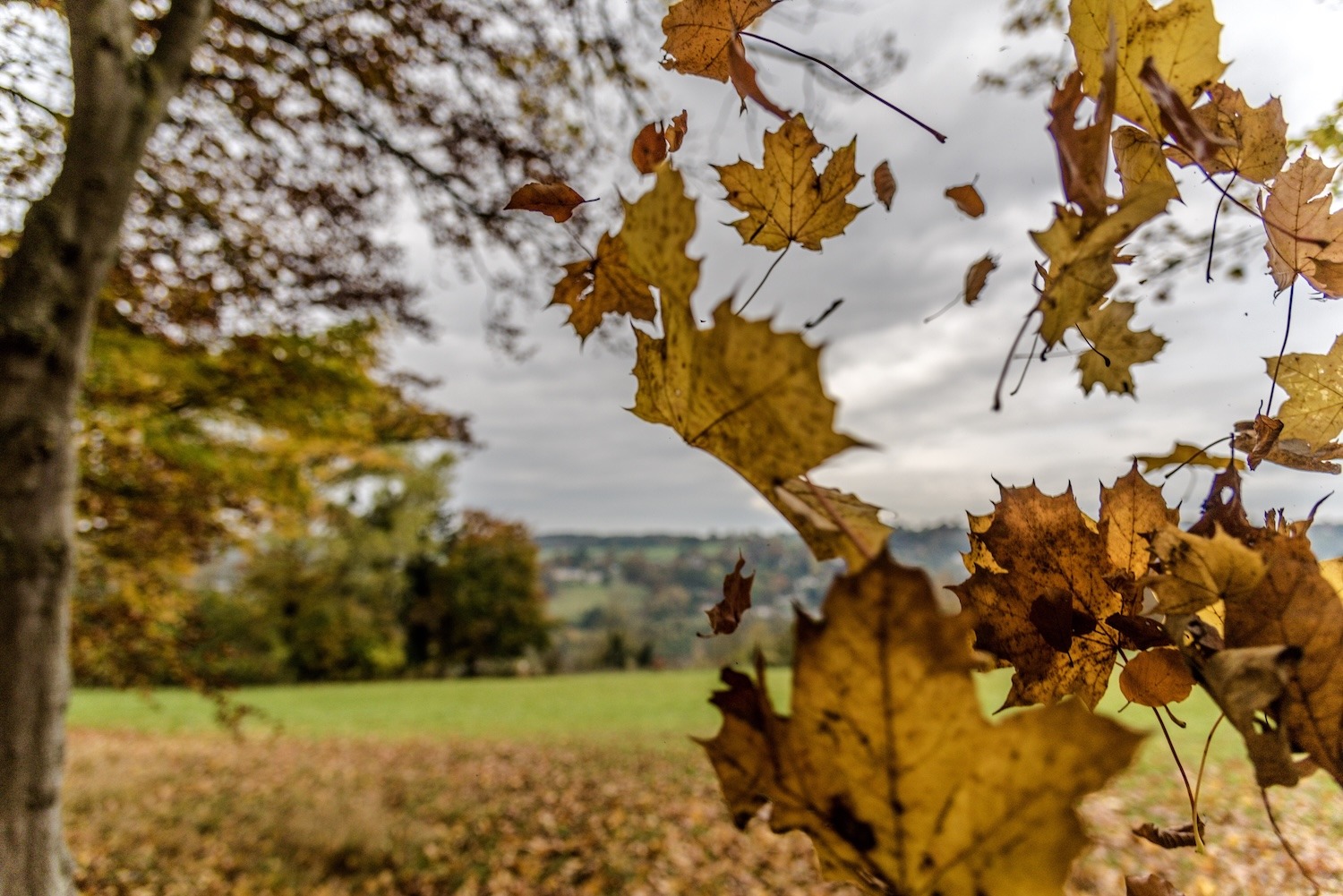
Seeing a tree lose its leaves in August or September can be concerning, especially when surrounding trees are still green. Early leaf drop in Devon does not necessarily mean a tree is dying, but it can indicate that the tree is responding to drought, root disturbance, disease or another change in its growing environment.
For homeowners, landowners and estate managers, the important question is not simply whether leaves are falling early, but why.
Trees are living organisms and their appearance naturally changes through the seasons. However, unusual or severe leaf loss can provide useful information about tree condition, particularly when it affects one tree more than similar trees nearby.
What causes early leaf drop in Devon?
One of the most common causes of premature leaf fall during late summer is a shortage of available water.
Trees lose water through their leaves as part of normal physiological processes. During prolonged periods of warm, dry weather, soil moisture can fall to a point where a tree has difficulty replacing the water it is losing.
Reducing its leaf area can be one response.
Possible signs associated with drought or moisture stress include:
- Leaves wilting or curling
- Browning around leaf margins
- Faded or yellow foliage
- Premature leaf fall
- Reduced shoot extension
- Sparse foliage
- Dieback of smaller shoots or branches in more severe cases
The response varies considerably between species, sites and individual trees. A mature tree growing in deep, moisture-retentive soil may respond very differently from a recently planted tree beside a driveway.
That is why early leaf fall should be treated as a symptom rather than a diagnosis.
Is early leaf drop in Devon always caused by drought?
No. Similar symptoms can result from many different causes.
These can include:
- Pest or disease activity
- Root damage
- Soil compaction
- Waterlogging or poor drainage
- Excavation near the root system
- Changes in ground levels
- Construction activity
- Damage to bark or stems
- Herbicide or chemical exposure
- Natural variation between species
- Normal seasonal changes following particular weather conditions
Problems below ground are particularly easy to overlook.
A tree may appear relatively unaffected immediately after a driveway is installed, a trench is excavated or soil is stored around its base. Symptoms can emerge later as the tree responds to root loss, compaction or altered drainage.
If a tree has changed noticeably following building or landscaping work, that history can be extremely useful when investigating the cause.
Compare the tree with its surroundings
One useful first step is observation.
Look at other trees of the same or similar species nearby. If several are beginning to colour and shed leaves at roughly the same time, the change may be associated with seasonal conditions.
If one individual tree is behaving very differently, further investigation may be worthwhile.
Also look at how symptoms are distributed through the crown.
For example:
- Is the whole crown affected?
- Is only one side deteriorating?
- Are individual branches dying back?
- Is the upper crown becoming sparse?
- Did symptoms appear suddenly?
- Have they become progressively worse over several years?
Patterns can sometimes provide useful clues, although a professional assessment may still be needed to establish the underlying cause.
Which trees are most vulnerable to late-summer stress?
Although any tree can be affected by difficult growing conditions, some trees require particular attention.
Newly planted trees
Recently planted trees have not yet developed the extensive root systems of well-established specimens.
Their root systems are initially concentrated around the original rootball and immediate planting area, which can make them particularly vulnerable during prolonged dry periods.
Consistent establishment watering is therefore important during the first few growing seasons.
The appropriate amount depends on factors including:
- Tree size
- Species
- Soil type
- Drainage
- Exposure
- Recent rainfall
- Temperature
- Planting method
Rather than relying on a fixed amount in every situation, the aim should be to provide sufficient water to reach the active rooting area without creating prolonged waterlogging.
Trees growing in compacted ground
Compaction reduces pore space within soil and can restrict both oxygen and water movement.
Trees growing beside driveways, parking areas, heavily used paths and other hard surfaces may therefore have considerably less favourable rooting conditions than their appearance above ground suggests.
Repeated vehicle movement or material storage beneath trees can make the problem worse.
Trees affected by construction
Excavation, trenching, new services, extensions, landscaping and changes to drainage can all affect tree roots.
Where development is planned around established trees, professional arboricultural input at an early stage can help identify constraints and protect important rooting areas.
Devon Tree Services provides arboricultural consultancy and tree survey services for homeowners, developers and land managers throughout Devon.
Trees on exposed sites
Trees growing on exposed hillsides, coastal sites or open ground may experience greater wind and solar exposure than sheltered trees.
This can increase moisture demand and influence how quickly soil and foliage dry during warm weather.
Again, species and site conditions matter.
How can you help a tree showing early leaf drop?
The correct response depends on the cause. Automatically watering, fertilising or pruning a declining tree without understanding the problem is not always beneficial.
There are, however, some sensible precautions.
Water establishing trees appropriately
When watering is required, a thorough application to the rooting area is generally more useful than repeatedly wetting only the soil surface.
The objective is to make water available to roots rather than simply spraying foliage.
Monitor soil conditions as well. Persistently saturated soil can be just as problematic for some trees as dry soil.
Use mulch correctly
Organic mulch can help conserve soil moisture, moderate temperature fluctuations and reduce competition from grass and weeds.
It should be spread over the rooting area rather than piled against the trunk.
A mound of mulch directly against the stem can create unfavourable conditions around the bark and root collar, so leave the immediate base of the tree clear.
Avoid further root disturbance
If a tree already appears stressed, avoid unnecessary:
- Excavation
- Trenching
- Soil level changes
- Vehicle parking
- Material storage
- Heavy machinery movement
around its rooting area.
Be cautious with pruning
Significant pruning is not automatically the answer to drought-related symptoms.
Where pruning is justified, the objective and timing should be chosen according to the tree, its condition and the reason for the work.
Recognised pruning operations may include crown reduction, crown thinning, crown lifting, formative pruning and deadwood removal where appropriate.
All pruning by Devon Tree Services is undertaken in line with BS3998:2010 and relevant environmental legislation.
Photograph and monitor changes
If you notice early leaf drop in Devon, taking photographs is a useful way to establish whether the condition is changing.
Photograph:
- The complete tree
- The crown from several angles
- Areas of dieback
- Unusual leaves
- Bark abnormalities
- Fungal fruiting bodies
- The soil and root area
- Nearby construction or ground disturbance
Repeat the photographs from approximately the same positions over time.
A simple record can make it much easier to distinguish a temporary response from progressive deterioration.
When should you ask an arboriculturist?
Professional advice is sensible where:
- A large proportion of the crown loses leaves unusually early
- Symptoms worsen from year to year
- Larger branches are dying back
- Fungal fruiting bodies appear on the trunk, roots or major branches
- Significant cracks or structural changes are visible
- Root damage or construction has occurred nearby
- The tree has developed a new or increasing lean
- Several different symptoms appear together
- The tree is positioned close to a house, road, path or another frequently used area
A professional assessment does not automatically mean recommending tree surgery.
Depending on the findings, the appropriate response could be monitoring, improved establishment care, changes to the rooting environment, targeted pruning, further investigation or a more detailed tree risk assessment.
This proportionate approach reflects Devon Tree Services’ wider aim of enhancing relationships between people and trees.
Early leaf drop does not automatically mean tree removal
Perhaps the most important point is that leaves falling early are not, by themselves, evidence that a tree needs to be felled.
Trees can respond visibly to short-term environmental pressures and subsequently recover.
Equally, recurring or severe symptoms should not simply be dismissed as drought without considering other possible causes.
The best approach is to look at the complete picture: the tree’s species, history, growing environment, recent weather, roots, crown condition and surrounding land use.
For further professional information about tree care and arboriculture, visit the Arboricultural Association.
Concerned about a tree in Devon?
Early leaf drop in Devon is often a visible response to environmental stress, but establishing the underlying cause is the important part.
If your tree is losing foliage unusually early, showing dieback or has changed noticeably following drought, construction or ground disturbance, Devon Tree Services can assess its condition and explain the most proportionate next step.
Contact our team for qualified arboricultural advice across Devon.