Saplings grown from seeds of the Sycamore Gap tree are set to become part of a major new woodland at the National Trust’s Wallington estate in Northumberland.
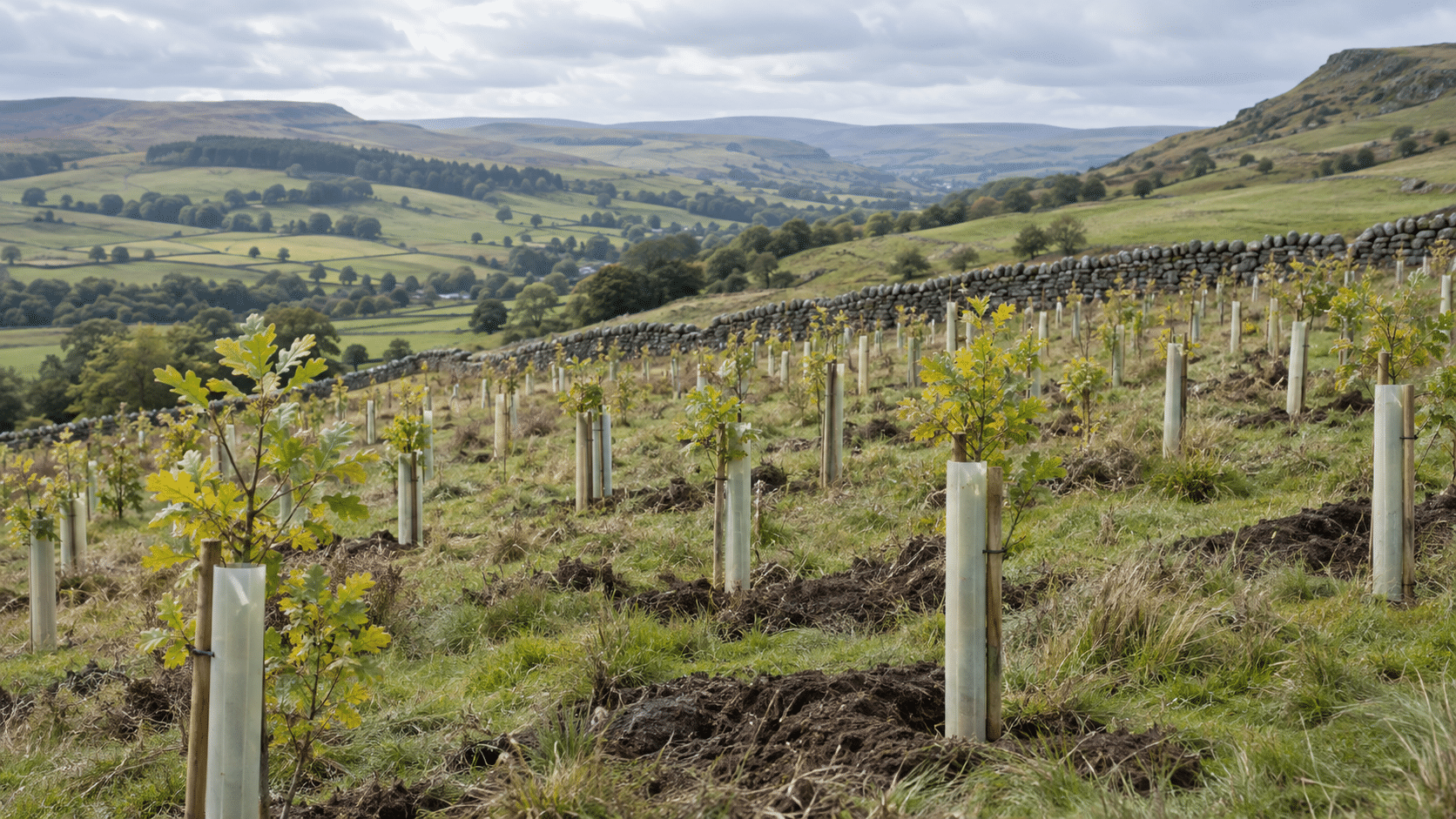
The project at Elf Hills involves planting 169,000 trees across 109 hectares. Five saplings grown from seeds of the illegally felled Sycamore Gap tree will be included through the Trees of Hope initiative. BBC News
The news brings together two different scales of tree planting: a large landscape project and a small number of young trees carrying a powerful public connection.
What is the latest Sycamore Gap planting news?
The Sycamore Gap tree stood in a dip beside Hadrian’s Wall in Northumberland and was one of the most photographed trees in the country. Its illegal felling in September 2023 prompted a public reaction that few could have predicted, with people sharing photographs, memories and proposals for how its legacy should continue.
Seeds and material collected from the tree have since been nurtured by the National Trust, and the first saplings are now being planted out through the Trees of Hope initiative, with the five Wallington saplings among the most prominent to reach the ground so far.
A new woodland with several purposes
According to the National Trust’s plans reported by the BBC, the new woodland will include areas intended primarily for wildlife, productive forestry and open pasture.
The scheme forms part of the charity’s ambition to plant one million trees across the Wallington estate by 2030. More than 500,000 have been planted there since 2021.
This is not simply a proposal to fill every available space with trees. The different land uses are part of the wider landscape plan.
For readers considering planting on their own land, it is a useful reminder to think about purpose and layout before focusing on totals.
How can people get involved?
Community planting sessions at Wallington are planned for 21, 24 and 25 November, coinciding with National Tree Week.
People of different ages and experience levels are being invited to take part, with no specialist equipment or previous planting experience required. Transport from the visitor reception to the planting site is being arranged.
Anyone considering attending should check the National Trust’s current event information before travelling, as arrangements may change.
Although this project is in Northumberland rather than Devon, its combination of community participation, landscape planning and shared history makes it relevant well beyond the estate.
Why do five saplings attract so much attention?
Within a project involving 169,000 trees, five saplings represent a very small proportion of the planting.
Yet their connection to Sycamore Gap makes them a central part of the story. These young trees carry an association with a tree whose loss prompted widespread public attention, and their inclusion gives people a tangible connection to its continuing legacy. BBC News
For us, this highlights something important: people do not experience trees only as statistics.
A tree can mark a place, hold a memory or connect generations of people. That meaning may not appear in a planting total, but it can strongly influence how people value and care for trees.
New planting is a beginning, not an instant replacement
The Wallington story is hopeful because it looks forward.
However, planting young trees and retaining established trees should not be treated as interchangeable decisions. In our work, we consider the condition and role of an existing tree before deciding whether removal is justified.
A newly planted sapling will take decades to offer the canopy cover, habitat and presence of the mature tree it follows. That is not an argument against planting; it is an argument for caring properly for the trees we already have while the next generation grows.
Where removal is necessary, replacement planting can be part of a considered management plan. But it should follow an assessment of the circumstances, not be used as an automatic answer to every concern.
This is particularly relevant when a mature tree has become part of the character of a garden, street or community.
What can Devon homeowners and landowners take from the story?
You do not need space for a large woodland to take a long-term approach to planting.
For a garden, school, estate or business site, the useful questions are similar:
- What do you want the planting to achieve?
- Which existing trees should remain part of the plan?
- How much room will new trees need as they grow?
- Who will care for them after planting?
- How can people using the site understand and value the trees?
For practical planting, correct depth, suitable ground conditions and ongoing maintenance all matter. The RHS identifies deep planting as a common cause of tree failure and advises against planting in frozen or waterlogged soil. RHS guidance
A meaningful planting project still needs sound practical foundations.
Tree advice that looks beyond the immediate job
At Devon Tree Services, we want clients to feel confident about the decisions they make for their trees.
Our qualified arboriculturists can advise on tree condition, risk, retention and longer-term management. Where work is required, our trained arborists can carry it out. Where a tree is better retained, monitored or investigated further, that should be reflected in the advice.
The Wallington project is a national story, but its underlying theme is close to our own values: trees help connect people with places, with each other and with the future.
The most worthwhile legacy is not simply planting something. It is creating the conditions, practical and personal, for people to care for it over the years ahead.